Being Heumann: Why a 1977 Sit-In Still Matters in a Therapy Office

Anna Johnson, LMHC
Spokane-based trauma and dissociation therapist. Telehealth across Washington State.
Being Heumann is an Apple Original Film about Judy Heumann and the 1977 Section 504 sit-in. Its subject is not only disability history. It is also who gets heard, whose needs are treated as reasonable, and what people do when institutions keep delaying their rights.
The film’s page is on Apple TV: 2 hr 7 min, rated R for language, some sexual material and drug use. It will be available with closed captions, SDH subtitles, and audio description. The trailer is on the same page.
The film is directed by Siân Heder, who directed CODA. Ruth Madeley plays Heumann. Mark Ruffalo plays Joseph Califano, then U.S. Secretary of Health, Education and Welfare. Dylan O’Brien plays reporter Evan White. The screenplay is by Heder and Rebekah Taussig. The film is based on Heumann’s memoir, Being Heumann: An Unrepentant Memoir of a Disability Rights Activist.
Apple’s trailer opens with Heumann saying, “Disability is not a tragedy, it is a tremendous hassle.” That line is a refusal to turn disabled people into symbols of courage or pity. It points to daily barriers, and to the people and policies responsible for them.
The film premiered as the opening-night selection at the Toronto International Film Festival and at the BFI London Film Festival. It opens in select theaters November 6, 2026, and streams on Apple TV starting November 13. This is not a review. The film has not yet opened. This is context for its subject and its relevance to care.
What happened in 1977
Section 504 of the Rehabilitation Act of 1973 prohibited disability discrimination in programs receiving federal financial assistance. It was the first U.S. federal law to recognize disability as a civil rights category. But the regulations needed to enforce it were delayed for years.
On April 5, 1977, disability-rights protests began in cities across the country. In San Francisco, Judy Heumann and other organizers led protesters into a federal building at 50 UN Plaza. They stayed for 26 days, demanding that the government sign the Section 504 regulations without weakening them.
The protesters organized food, communication, medical needs, and other essentials. The Black Panthers provided meals and supplies. Their support was not incidental. It helped make a prolonged protest possible.
On April 28, Califano signed the regulations. The San Francisco protesters left the building after 26 days. The National Park Service describes the sit-in as the only one of the nationwide protests to continue beyond the first few days. Its history of the 504 protest details the occupation and the coalition that sustained it.
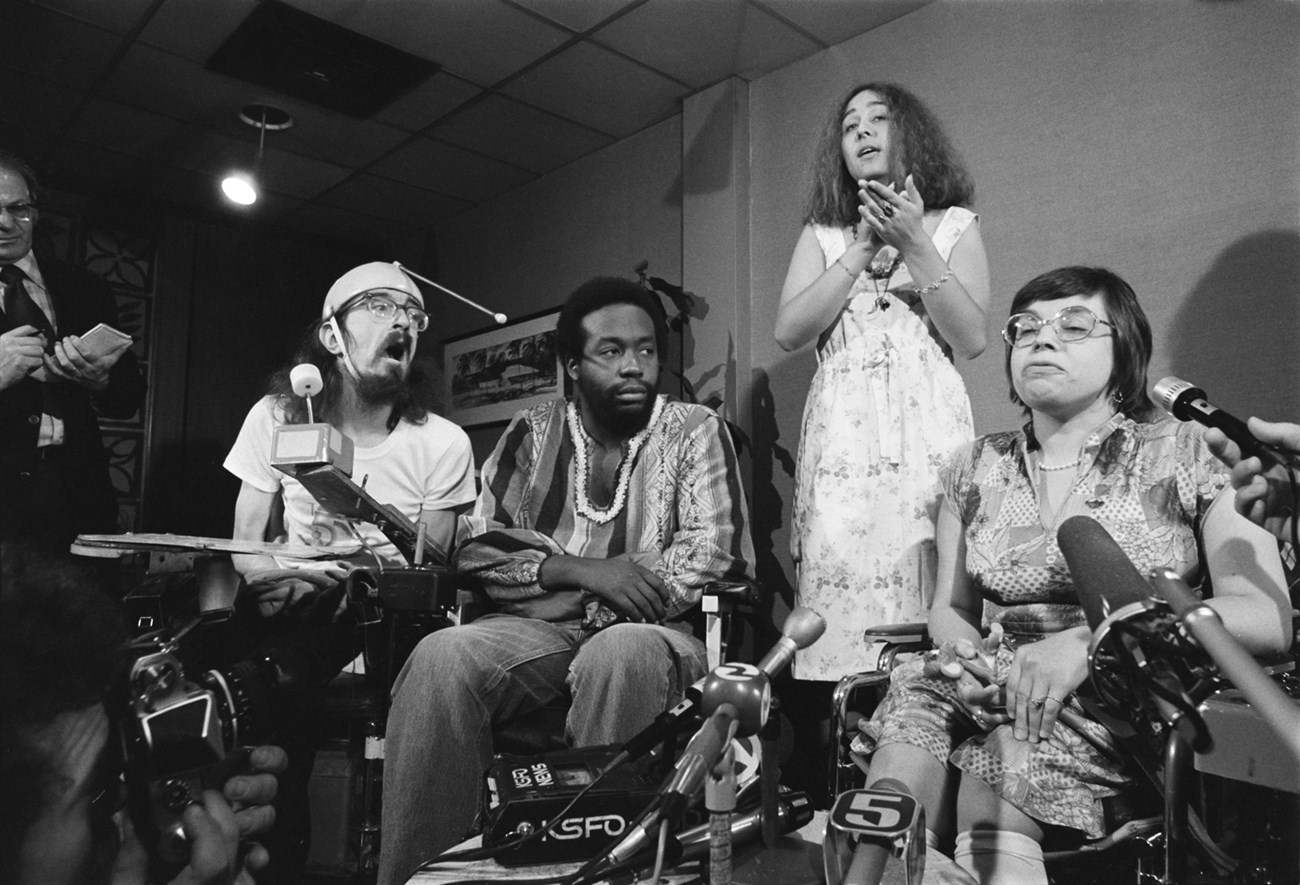
Section 504 did not create every disability right that followed. The Americans with Disabilities Act came later, in 1990, and the Fair Housing Act has its own legal framework and rules. These laws are distinct. But the 504 sit-in helped establish that disability access was a civil rights issue, and that people denied access would organize to demand enforcement.
Access rights were fought for
Rights can look routine once they are written into policy. They were not inevitable. People with disabilities occupied a federal building for weeks because a law without enforceable regulations left their rights out of reach.
That history connects to practical questions in therapy and daily life. My post, Support Animals, and the Two Cats Who Run Fully You Therapy, explains the different rules for ADA service animals and assistance animals in housing under the Fair Housing Act. Those categories are not interchangeable. They exist within separate legal frameworks, shaped by a longer struggle over access, participation, and whose needs institutions must take seriously.
The point is not that one protest created every protection. It is that rights require people to name barriers, organize, and insist that institutions follow through. “That’s not how we do it” is not, by itself, a legal explanation.
Belief is part of access
Heumann’s story also concerns credibility. Disabled people were often treated as objects of charity rather than people with rights. Their requests could be dismissed as excessive simply because meeting them required change.
That dynamic has a place in clinical care. In What Dissociation Isn’t: How Race, Disability, and Gender Shape Who Gets Believed, I write about how bias can shape who is believed when they describe dissociation and trauma. “Being believed shouldn’t depend on who you are” is not a slogan. It is a standard of care.
A person’s memory may be incomplete. Their account may change as they understand more. They may speak with little visible emotion, or struggle to put an experience into words. Those facts do not automatically prove that someone is lying or unreliable. A clinician has a responsibility to ask better questions, consider context, and avoid treating one presentation of distress as the only credible one.

What does a sit-in have to do with someone who loses time?
Trauma clients and people with dissociative identity disorder may live with experiences others cannot see. Some also have disabilities. They may know what it is like to describe lost time, memory gaps, or internal experiences and be doubted, or to have someone else decide what those experiences mean before asking.
A 504 sit-in was a political protest, not a therapy model. But its dignity argument applies: people have the right to name what they need and take part in decisions that affect them. Rights you can invoke were won by people refusing to be managed instead of heard. In therapy, that same argument underlies asking a clinician to assess an experience they might rather not see. A dissociation specialist should not ask you to make your history smaller to fit an assumption.
If you are looking for care, Looking For a Dissociation Specialist? Here Are 10 Things You Should Know offers questions to ask about training and approach. For complex PTSD therapy, look for a provider who can discuss trauma, dissociation, pacing, and access needs directly. Therapy by telehealth can also reduce some practical barriers, though it does not solve every access problem.
Do and Don’t
Do
- Watch the official trailer or the film when it is released.
- Learn what Section 504 protects.
- Notice who is told their request is “too much” in your own care.
- Bring access needs to a provider without apologizing for having them.
- Support disabled-led organizations and advocacy.
Don’t
- Assume access rights were always there.
- Accept “that’s not how we do it” without asking what rule or reason supports it.
- Treat disabled people’s anger as unreasonable by default.
- Wait for someone else to define what you need.
Being Heumann gives viewers a way to look at a specific moment in disability rights history. The history is documented by the National Park Service; the film’s details and release information are on Apple TV Press. The question it leaves for a therapy office is concrete: are people being heard as participants in their care, or managed as problems to contain?
Anna Johnson, LMHC, provides trauma and dissociation therapy by telehealth across Washington State. She is based in Spokane and offers a free 15-minute consultation.